Background and Current Status
Based on pain point research, this system targets complex voice interaction scenarios for embodied intelligence and adopts an integrated design of a microphone array pickup module, a speaker module and acoustic algorithms, enabling sound source localization, beamforming and speech enhancement processing.
The system can effectively suppress lateral interference and multi-speaker interference, improve the signal-to-noise ratio (SNR) of target speech and recognition stability, support operation on embedded platforms, and feature excellent scalability and scenario customization capabilities.
Pain Point Analysis
However, in complex and noisy environments, the accuracy of speech recognition still faces considerable challenges. The main causes of this problem are heavy background noise and diverse speech sources, which greatly undermine the accuracy of speech recognition and the overall interactive experience.
Speech signals are highly susceptible to interference. The application environments of embodied intelligence are complex and diverse, often accompanied by environmental noise, interfering sound sources, reverberation and other factors. These issues distort speech signals and lead to difficulties in speech recognition. For example, in household scenarios, there may be various noises such as TV audio and electrical appliance operation sounds; in industrial scenarios, the roaring noise of machinery causes severe interference to speech input.
Challenges of Far-Field Voice Interaction:In far-field voice interaction scenarios, the distance between embodied intelligence and users is relatively large. Speech signal intensity attenuates as distance increases, while the effects of reverberation and background noise become even more pronounced. This results in a significant decline in far-field speech recognition accuracy, limiting the application scope and interaction performance of embodied intelligence.
Challenges in Multi-Speaker Scenarios:When multiple speakers are present in the environment, embodied intelligence struggles to accurately identify the speech of the target speaker. Problems such as speech signal confusion and recognition errors frequently occur, making it unable to meet the interaction requirements of multiple users.
Limitations of Existing Noise Reduction Technologies:Traditional noise reduction algorithms such as spectral subtraction and Wiener filtering tend to lose part of the speech signal while suppressing noise, resulting in speech distortion. This makes it difficult to meet the high speech quality requirements of embodied intelligence.
3.System Introduction
Based on pain point analysis, this system targets complex voice interaction scenarios for embodied intelligence. It adopts an integrated design of a microphone array pickup module, a speaker module and acoustic algorithms to realize sound source localization, beamforming and speech enhancement processing.
The system can effectively suppress lateral interference and multi-speaker interference, improve the signal-to-noise ratio (SNR) of target speech and recognition stability. It is compatible with embedded platforms and features excellent scalability and scenario customization capabilities.
4.System Advantages
Compared with general pickup solutions, this system offers the following advantages:
1. Scenario Customization Capability
Optimized for the specific application environments of embodied intelligence, rather than adopting general template-based processing.
2. Strong Anti-interference Capability
Suppress lateral and rear voice interference
Improve the stability of target speech recognition
Reduce false trigger probability
3. Full Edge-side Processing Pipeline
All-in-One: Localization + Beamforming + Enhancement
Multi-Platform Compatibility
4. Reusability and Scalability
Adaptable to different array sizes
Portable across various embedded platforms
Supports customized parameters for different end products, enabling flexible integration into intelligent devices such as embodied robot heads, smart home appliances, and smart signage.
5.System Composition
1. Sound Pickup Module
Array Formats: 4-microphone or 6-microphone array, composed of multiple high-performance MEMS microphones, responsible for voice signal pickup.
Design Objective: To provide spatial direction information and multi-channel data support.
Core Functions:
Provide sound source direction information
Support real-time Direction of Arrival (DOA) estimation
Provide spatial resolution capability for beamforming
Improve the separability between target speech and interfering speech
The array design is optimized for the voice frequency band, balancing structural size and direction resolution, and is suitable for integration into the head or upper structure of embodied intelligence devices.
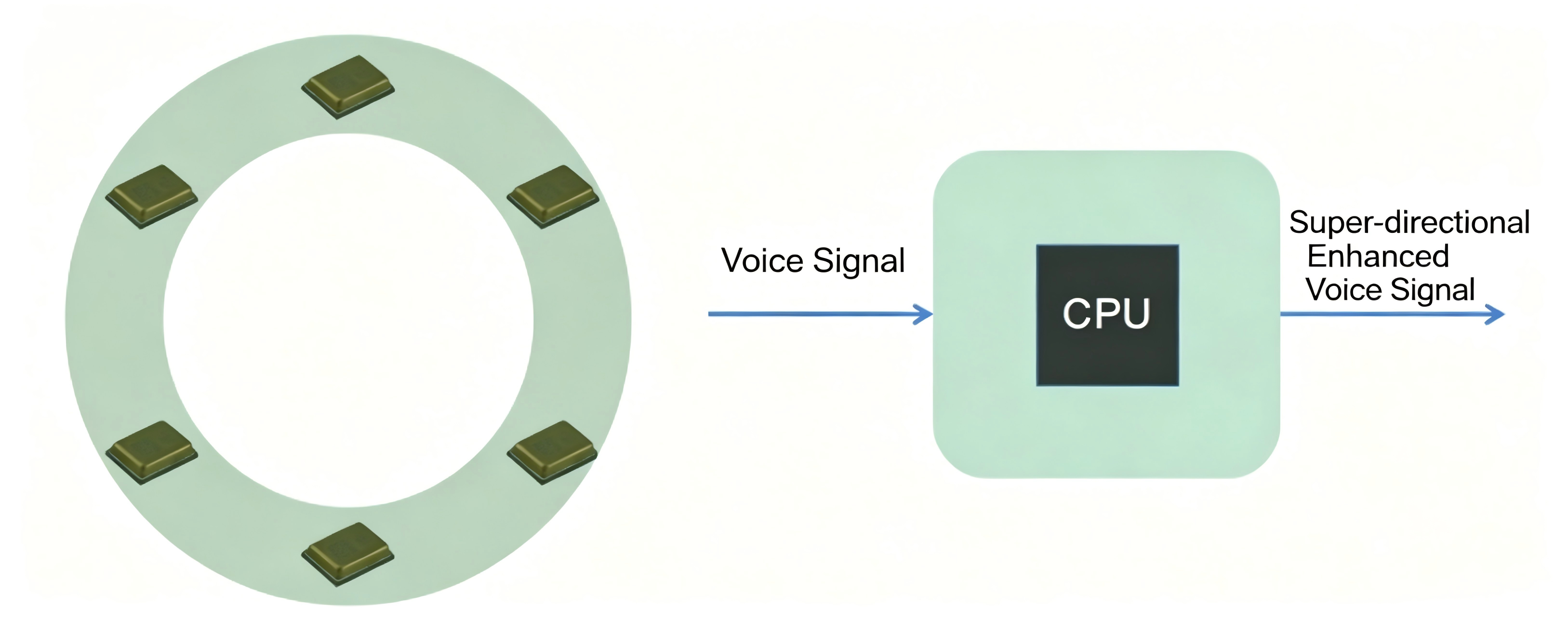
Schematic Diagram of Sound Pickup and Localization Module
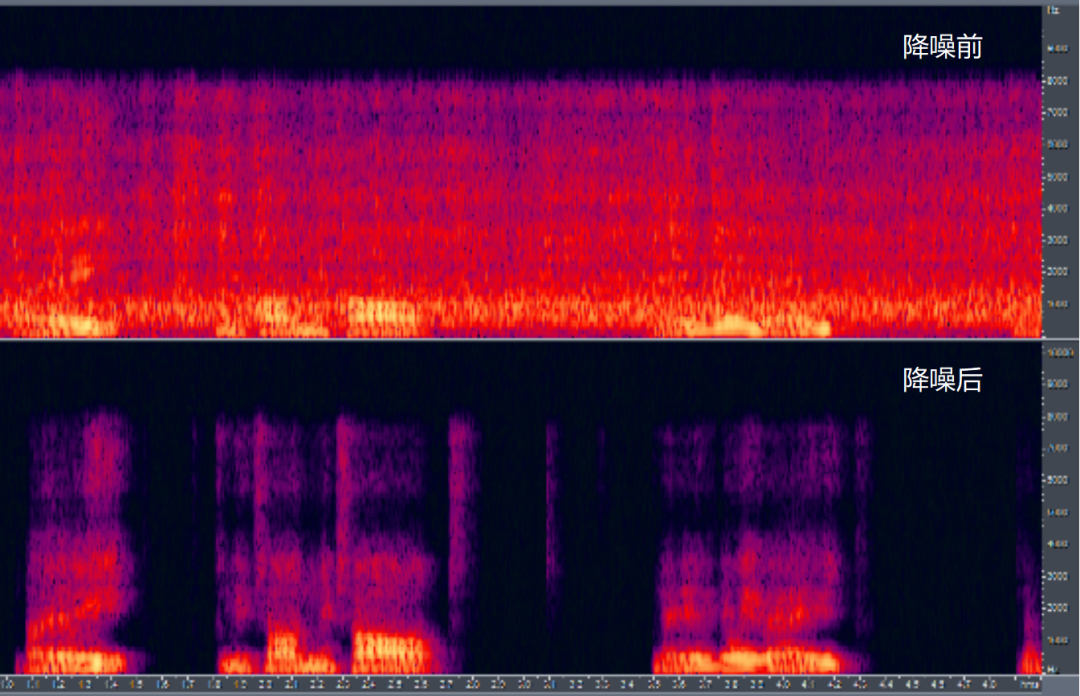
AI Noise Reduction Module:Composed of high-performance DSP and MCU, it performs voice signal preprocessing, AI model noise reduction, and outputs denoised voice signals. Embedded with a lightweight noise reduction model, it features fast running speed and low power consumption.
2. Sound Output Module
This solution fully takes into account the impact of the embodied intelligence’s own speakers on the sound pickup system during the design phase:
Isolation optimization in physical structure
Echo suppression strategy adopted at the algorithm level
Support for full-duplex voice interaction
It ensures that when the embodied intelligence plays voice prompts, the quality of user voice collection will not be affected.
3. Acoustic Algorithm Module
This module runs on edge core boards such as RK3576 / RK3588, implementing a complete acoustic processing pipeline.
Functional Pipeline:
Multi-channel Audio Input → Sound Source Direction Estimation → Target Direction Tracking → Adaptive Beamforming → Speech Enhancement Output
3.1 Sound Source Direction Estimation
Real-time estimation of dominant speaker direction
Supports environments with multiple interfering sound sources
Provides directional basis for subsequent beamforming control
Using a circular microphone array and the TDOA (Time Difference of Arrival) algorithm, the system locates the azimuth of the primary interactive target sound source. Combined with filtering algorithms, it tracks the azimuth of the interactive target sound source in real time and performs directional enhancement on the target speech.
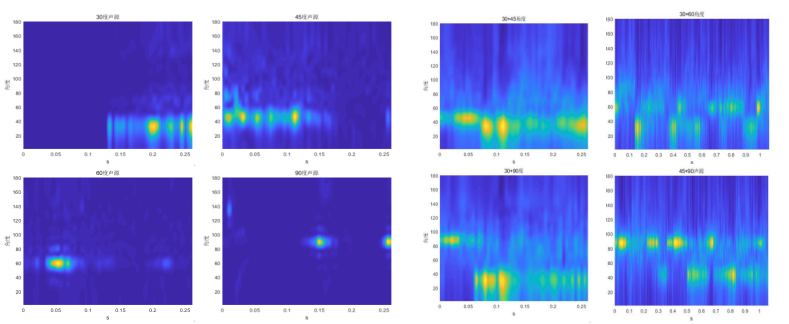
Single-source (Left) vs. Dual-source (Right) Sound Localization Performance
3.2 Adaptive Beam Control
Dynamically adjusts beam steering according to the target direction
Suppresses speech from non-target directions
Improves the signal-to-noise ratio (SNR) of target speech
3.3 Speech Enhancement Output
Improves the clarity of target speech
Reduces the impact of environmental interference on ASR
Provides stable input for downstream speech recognition systems
6、Typical Application Scenarios
Multi‑user Interaction for Embodied Intelligence
Exhibition & Commercial Space Guiding & Presentation
Educational Embodied Intelligence Interaction
Companion‑oriented Embodied Intelligence Interaction
Interaction in Special Acoustic Environments
7、System Benefits
Benefits of Improved User Experience
Expanded Application Scenarios:This system enables embodied intelligence to perform normal voice interaction in various noisy environments. In high-noise settings such as factories, hospitals and shopping malls, embodied intelligence can act as auxiliary or service personnel to communicate efficiently with humans via voice, providing users with a wider range of services and broadening the application scope and practical value of embodied intelligence.
Improved Interaction Fluency:Through effective noise reduction, embodied intelligence can recognize users' voice commands accurately in real time, reducing interaction interruptions or misunderstandings caused by speech recognition errors. This makes communication between embodied intelligence and users smoother and more natural, greatly improving interaction efficiency. Users can obtain required services or information more conveniently. For example, in smart home scenarios, users can quickly instruct embodied intelligence to control home appliances without repeating commands.
System Performance Optimization Benefits
Improved Speech Recognition Accuracy:The noise reduction system accurately removes environmental noise interference and provides clearer, purer speech signals to the speech recognition module. This allows speech recognition algorithms to analyze and understand speech content more accurately, greatly improving recognition accuracy, reducing false triggers and misrecognition, and enhancing system reliability and stability.
Efficient Utilization of Computing Resources:High-quality noise reduction processing eliminates redundant information and noise components from speech signals, making subsequent processes such as speech recognition and semantic understanding more efficient. It reduces computing resource consumption, improves overal.
Enhanced Safety & Reliability Benefits
Accurate Execution of Critical Instructions:In scenarios with stringent safety requirements such as industrial production and emergency rescue, embodied intelligence can accurately receive and execute critical voice commands, avoiding potential hazards and accidents caused by speech recognition errors, and ensuring the safety and reliability of its operations.
Improved System Stability:An effective noise reduction system reduces uncertainties in speech input, enabling more stable operation of the entire voice interaction system. It minimizes system faults or anomalies caused by speech-related issues, ensuring the stability and reliability of embodied intelligence during long-term operation.
Benefits of Commercial Value Enhancement
Enhanced Product Competitiveness:Embodied intelligence equipped with high-performance speech input noise reduction capabilities delivers a higher‑quality and more reliable user experience. It holds distinct competitive advantages over similar products, helping to strengthen market competitiveness, attract more users and customers, and thereby increase market share and sales volume.
Improved Brand Value:This system demonstrates the developer’s advanced expertise and innovative capabilities in the field of voice interaction technology. It helps establish a strong corporate image in high-tech sectors, enhances brand awareness and reputation, and brings more business opportunities and brand value appreciation to the enterprise.