1. Industry Background
Rotating machinery is widely deployed in industrial production scenarios, including pumps, compressors, generators and other core equipment. Its operational performance directly determines the stability and operational efficiency of the entire production line. With the continuous improvement of manufacturing automation and technological iteration, the design and performance of rotating equipment have been progressively optimized, while equipment failure rates have also increased accordingly.
As core industrial assets, rotating equipment is prone to unexpected failures that cause unplanned downtime. Such incidents not only result in direct economic losses ranging from tens of thousands to hundreds of thousands of RMB per minute, but also severely disrupt production continuity and operational stability.
Traditional operation and maintenance models for rotating equipment expose prominent pain points. These include resource waste caused by excessive maintenance, low efficiency of manual inspection, insufficient recognition capability for early weak faults, and widespread industrial data silos. There is an urgent industry demand for intelligent predictive maintenance solutions to address these bottlenecks.
2. Allinby Releases a New Intelligent Monitoring Solution
Leveraging in-depth accumulation of high-performance sensor hardware technologies and professional software development capabilities, Beijing Allinby has long focused on the field of equipment fault monitoring. The company launches an integrated monitoring technology featuring distributed architecture plus cloud platform.
Relying on real-time data collection, lightweight data transmission and online AI diagnostic capabilities, the solution builds a full-lifecycle intelligent monitoring system for industrial equipment. It enables early detection, early warning and timely maintenance of potential equipment faults, effectively reducing unplanned downtime and improving overall industrial operational reliability.
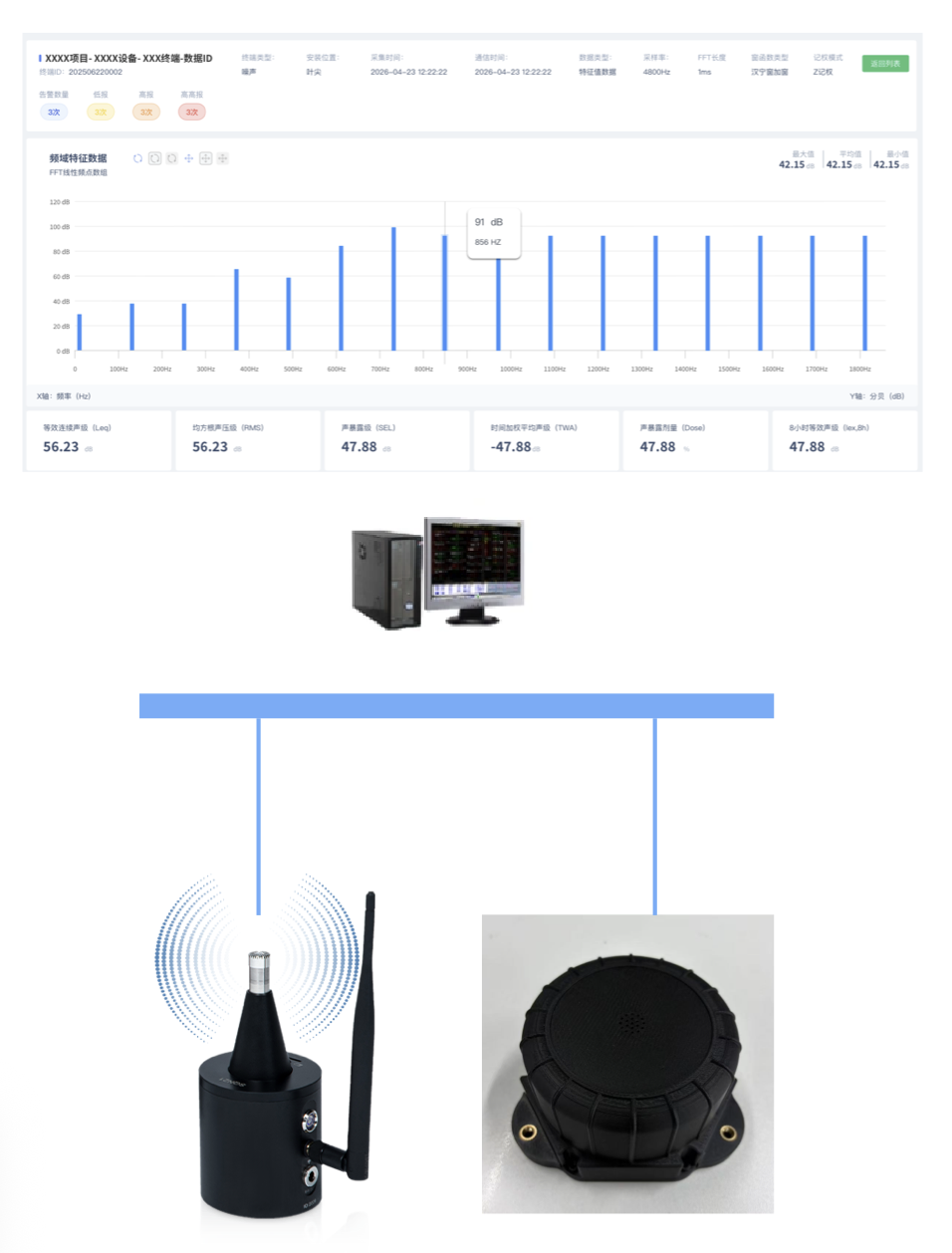
The Allinby Fault Monitoring System adopts a three-tier architecture consisting of the Perception Layer, Network Layer, and Platform Layer, delivering full-link assurance for accurate data collection, stable transmission and intelligent diagnosis.
Perception Layer: Distributed High-Precision Collection
Wired and wireless distributed sensors are deployed to real-time acquire signals such as equipment vibration, temperature, rotational speed and voiceprint. The system completes signal conversion and conditioning, extracts key characteristic values, and stores raw data locally to ensure complete information integrity.
Network Layer: Multi-Protocol Stable Transmission
It supports multiple transmission protocols including 5G, Wi-Fi and Industrial Ethernet, enabling real-time and scheduled stable data upload. Adaptable to diverse industrial network environments, it effectively prevents data loss.
Platform Layer: AI-Driven Intelligent Diagnosis
The cloud platform conducts in-depth signal processing and automatically extracts core indicators such as spectrum, energy and kurtosis. Powered by AI intelligent diagnosis algorithms, it compares data with the equipment health baseline model to detect anomalies in real time and accurately identify fault types, with a diagnosis accuracy rate exceeding 95%.
3. Core Capabilities
(1) Digital Twin, Full Visibility of Equipment Status
3D modeling is implemented for industrial equipment and production lines with real-time mapping to physical devices. Monitoring data is displayed intuitively, enabling full mastery of equipment operation status without on-site inspection.
(2) Intelligent Alarm, Second-Level Early Warning with Zero Latency
Built-in high-precision intelligent alarm algorithms capture data anomalies in real time, trigger alarms and push reports within seconds to prevent fault escalation.
(3) Intelligent Diagnosis, Accurate Differentiation Between Faults and Working Condition Fluctuations
Upon alarm activation, the system automatically compares algorithm models to accurately distinguish actual faults from normal working condition fluctuations. The algorithm model undergoes continuous iterative optimization to adapt to fault diagnosis in multiple scenarios.
(4) Advanced Analysis to Support In-Depth Manual Research & Judgment
Professional analysis tools including trend comparison, waveform spectrum, acceleration envelope and order analysis are provided, assisting engineers in in-depth analysis of complex faults and rapid localization of root causes.
4. Industry Applications
Beijing Allinby fault monitoring technology adapts to complex scenarios featuring long-duration operation, high sampling frequency and unmanned on-site operation. It has been deployed and applied in multiple industrial sectors, providing customized equipment monitoring solutions for customers across industries.
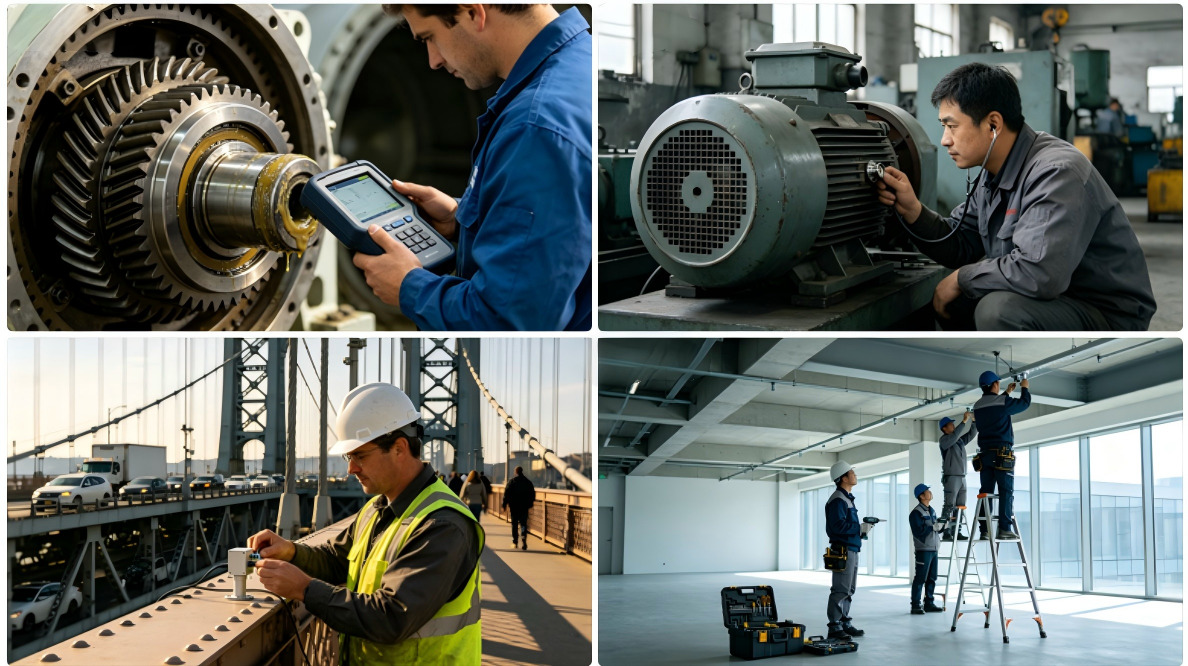
Wind Power Equipment Monitoring: Targeting fault-prone core components such as wind power gearboxes, blades and main shaft bearings, it integrates acoustic emission and voiceprint recognition technologies to accurately identify early potential equipment faults. It delivers advance early warnings and guides predictive maintenance, effectively reducing downtime and maintenance costs and ensuring stable operation of wind farms.
Mechanical Abnormal Noise Diagnosis: Precisely locates abnormal noise sources of rotating equipment including motors, pumps and bearings, and automatically identifies fault types and severity. It replaces the traditional manual stethoscope inspection mode, greatly improving the efficiency and accuracy of fault diagnosis.
Bridge & Building Structural Health Monitoring: High-sensitivity acoustic emission monitoring systems are deployed to capture weak signals of structural crack propagation. It realizes all-weather online structural damage monitoring, provides timely early warnings of potential safety hazards, and guarantees the long-term safety and stability of infrastructure such as bridges and buildings.
5.Customer Value
Leveraging full-process intelligent monitoring and predictive maintenance capabilities, Allinby’s distributed cloud-based fault monitoring technology delivers multi-dimensional core values for industrial enterprises:
Mitigate safety risks and secure production baseline: The system provides early warnings of potential equipment defects at the initial stage, significantly reducing the occurrence of unplanned downtime and safety incidents. It ensures continuous production and safeguards the safety of on-site personnel and industrial equipment.
Cut operational and maintenance costs and optimize resource allocation: It reduces the workload of manual inspections, eliminates ineffective inventory occupation of spare parts, and avoids resource waste caused by excessive maintenance, thereby achieving a substantial reduction in overall operational and maintenance expenses.
Improve equipment reliability and extend service life: Early equipment faults can be detected and handled in a timely manner, preventing irreversible damage caused by fault deterioration. This effectively prolongs the service life of equipment and supports long-term and stable operational performance.
Empower human resources and boost O&M efficiency: The 7×24-hour unattended monitoring mode replaces traditional manual on-duty supervision, relieves the workload of operation and maintenance personnel, enables the team to focus on high-value work, and improves the overall efficiency of equipment operation and maintenance management.
Against the backdrop of industrial intelligent upgrading, equipment operation and maintenance is undergoing an accelerated transformation from traditional passive maintenance to proactive prediction and full lifecycle management. Centered on distributed and cloud-based fault monitoring technology, Beijing Allinby empowers the entire process of industrial equipment maintenance with technological innovation. It helps enterprises eliminate unplanned downtime, realize modern industrial production with high efficiency, safety and low cost, and collaborates with industry partners to create a new landscape of intelligent industrial development.